
8 Archetypal Family Roles: The Peacekeeper Avoids Conflicts
May 15, 2026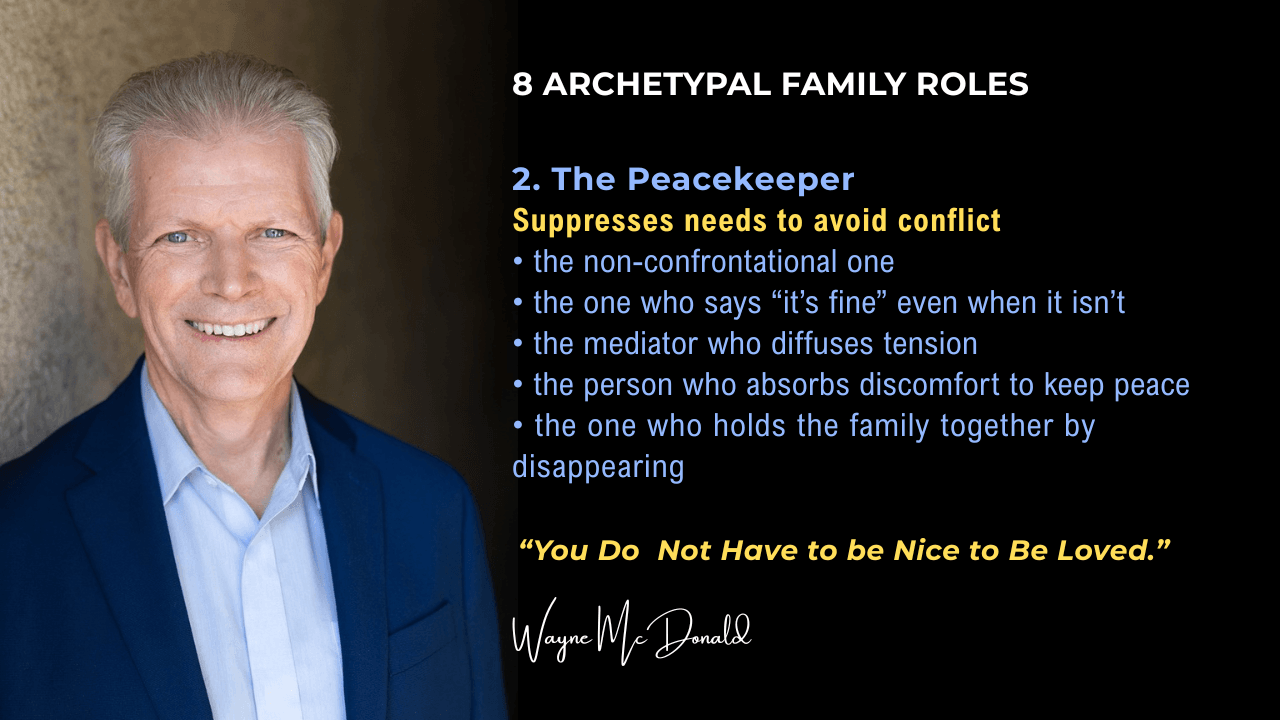
The Peacekeeper: The Person Who Learned to Keep Everyone Happy
Some people become experts at keeping the peace.
They smooth over tension.
Avoid conflict.
Stay agreeable.
Say “it’s okay” even when it really isn’t.
They become the calm one in the family — the person who tries to make sure everyone else feels comfortable.
But underneath that calm exterior is often someone quietly carrying stress, fear, and emotions they never learned it was safe to express.
In the Family Dynamics Method™, this role is known as The Peacekeeper — the person who learned to suppress their own needs in order to avoid conflict and maintain emotional harmony.
When Peace Starts Feeling Safer Than Honesty
Most Peacekeepers did not become this way because they naturally disliked conflict.
They became this way because conflict once felt emotionally unsafe.
Maybe arguments in the home were explosive.
Maybe expressing feelings led to criticism, punishment, or rejection.
Maybe one family member controlled the emotional atmosphere and everyone else had to adapt around them.
At some point, the child learns:
“If I stay quiet, agreeable, and easy to deal with, things will stay calmer.”
So they begin shrinking themselves emotionally in order to feel safe.
The Child Who Learned to Disappear
Peacekeepers often become highly aware of other people’s emotions.
They can sense tension quickly.
They notice mood changes immediately.
They instinctively try to prevent discomfort before it grows.
Over time, they may become:
- the mediator
- the people-pleaser
- the emotional absorber
- the one who avoids confrontation
- the person who keeps everything “fine”
But while they are busy protecting everyone else’s comfort, they slowly lose connection with their own needs.
Many Peacekeepers struggle to answer simple questions like:
“What do I actually want?”
“What do I truly feel?”
Because for so long, survival depended on focusing on everyone else first.
The Emotional Cost of Always Keeping the Peace
From the outside, Peacekeepers may appear calm, kind, cooperative, and easygoing.
Inside, however, they are often carrying:
- resentment
- emotional exhaustion
- anxiety around conflict
- fear of disappointing others
- guilt when speaking honestly
- difficulty setting boundaries
- loneliness from never fully expressing themselves
One of the deepest fears beneath this role is:
“If I speak up, I might lose love, connection, or safety.”
So instead of risking conflict, they stay silent.
Even when silence hurts.
Why Speaking Up Feels So Uncomfortable
For many Peacekeepers, honesty feels emotionally dangerous.
Not because they are weak — but because their nervous system learned to associate self-expression with emotional risk.
As children, they may have learned:
- disagreement creates chaos
- needs are inconvenient
- emotions upset people
- honesty causes rejection
So the body adapts by staying small, careful, and emotionally contained.
That is why even healthy conflict can feel overwhelming for someone in this role.
Their body is not reacting to the present moment alone.
It is reacting to old emotional conditioning.
The Healing Truth The Peacekeeper Needs to Hear
Healing begins when the Peacekeeper realizes something important:
Your needs matter too.
Your voice is not a problem.
Your honesty is not dangerous.
And real peace does not require self-abandonment.
For many Peacekeepers, this truth feels emotional because they spent years believing love depended on staying agreeable.
But true connection cannot grow where authenticity is constantly hidden.
Learning the Difference Between Peace and Silence
The Family Dynamics Method™ describes healing through three stages: Reveal, Transform, and BE.
REVEAL
The first step is recognizing that your silence was protective.
You were not weak for avoiding conflict. You adapted in the best way you knew how.
TRANSFORM
Next comes learning healthier emotional patterns.
You begin practicing boundaries. Speaking small truths. Expressing needs without apologizing for them.
Slowly, your nervous system learns that honesty does not automatically create danger.
BE
Eventually, you stop disappearing to keep others comfortable.
You begin speaking with calmness, clarity, and self-respect.
Not to create conflict — but to create authenticity.
Gentle Healing Practices for The Peacekeeper
Healing often begins with very small acts of self-expression.
Helpful practices may include:
- sharing one honest feeling each day
- practicing simple boundaries
- noticing when you automatically say “it’s fine”
- allowing yourself to disagree without guilt
- speaking your preferences out loud
- reconnecting with your own emotions and desires
One powerful affirmation for this role is:
“My truth creates healthy peace — not conflict.”
You Do Not Have to Disappear to Be Loved
The Peacekeeper often learned that harmony mattered more than authenticity.
But healing changes that story.
You begin realizing that real peace is not created through silence, suppression, or self-erasure.
Real peace happens when you can remain connected to yourself while also staying connected to others.
And little by little, you stop shrinking.
You stop apologizing for your voice.
And you finally allow yourself to exist fully in the room, too.
Ready to heal the wounds of your past? 💔
Discover the Family Dynamics Method™ by Wayne McDonald.
✨ Reclaim your wholeness.
✨ Release generational pain.
✨ Embrace the journey of—BEcoming more of your True Self.
Start your transformation today.