
8 Archetypal Family Roles: The Manager Holds Everything
May 15, 2026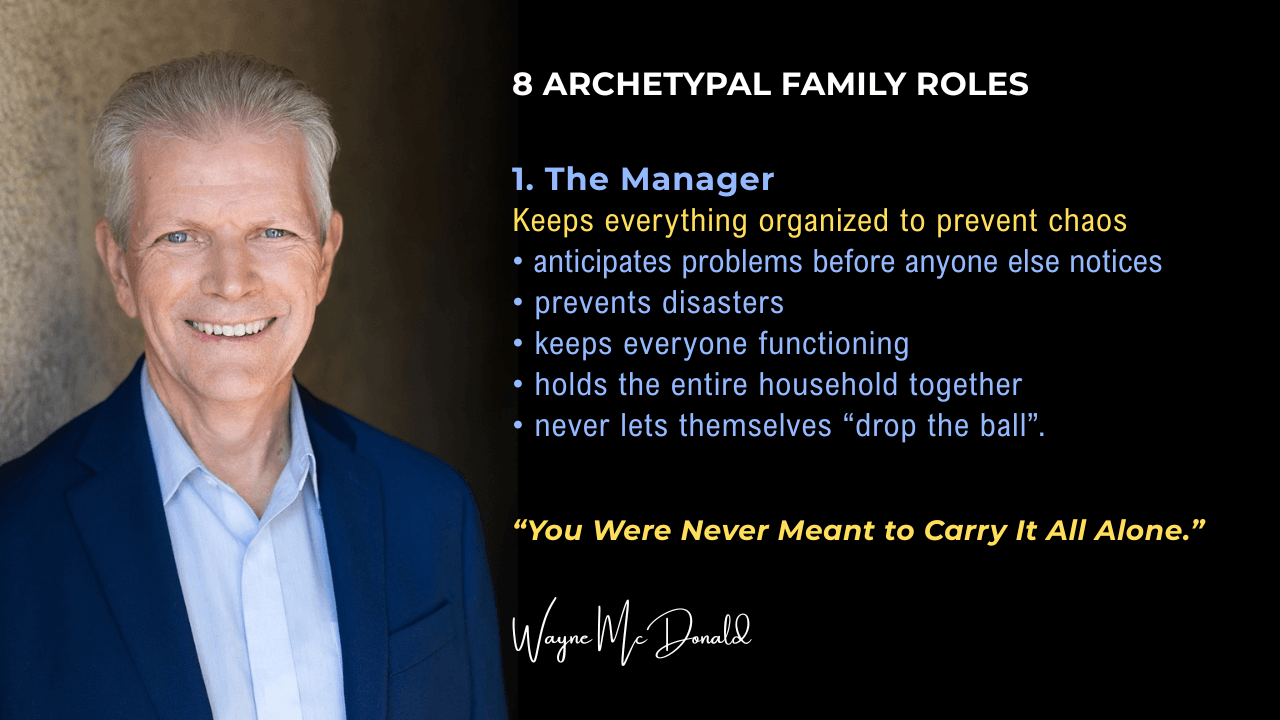
The Manager: The Person Who Learned to Hold Everything Together
Some people walk into a room and immediately begin noticing what needs to be fixed.
Who is upset.
What could go wrong.
What needs organizing.
What might fall apart if no one handles it.
They are the planners, the stabilizers, the responsible ones who seem to always stay one step ahead.
In the Family Dynamics Method™, this role is called The Manager — the person who learned early in life that staying in control felt safer than living in chaos.
When Control Starts Feeling Like Safety
Most Managers did not become this way because they naturally loved responsibility.
They became this way because unpredictability once felt emotionally unsafe.
Maybe there were explosive emotions in the home.
Maybe adults were inconsistent or overwhelmed.
Maybe the environment felt unstable, tense, or emotionally unpredictable.
As children, they learned something powerful:
“If I can stay organized, prepared, and aware, maybe things won’t fall apart.”
So they adapted.
They became the one who remembered everything.
Handled everything.
Managed everyone.
And quietly carried stress no child should have had to carry.
The Child Who Became Hyper-Responsible
Over time, being responsible stopped being a behavior and became an identity.
Managers often feel pressure to:
- keep everyone emotionally stable
- prevent problems before they happen
- stay productive at all times
- avoid mistakes
- hold everything together
Even when life becomes calmer, their nervous system may still act as though danger is right around the corner.
This is why many Managers struggle to truly relax.
Rest can feel uncomfortable.
Delegating can feel risky.
Asking for help can feel almost impossible.
The Exhaustion No One Sees
From the outside, Managers often appear highly capable.
People may compliment them for being dependable, organized, or “having it all together.”
But internally, many feel emotionally exhausted.
They may carry:
- chronic tension
- burnout disguised as competence
- anxiety around uncertainty
- resentment from always over-functioning
- guilt when slowing down
- fear that things will collapse without them
One of the deepest emotional truths beneath this role is:
“No one took care of me, so I learned to take care of everything.”
Why Letting Go Feels So Hard
For The Manager, control is rarely about perfection.
It is usually about protection.
Their body learned that staying alert prevented emotional pain. Their nervous system became wired for scanning, anticipating, and preparing.
Even after the original danger is gone, the body may still live as if crisis is always approaching.
That is why healing is not simply about “thinking positively” or “relaxing more.”
Healing means teaching the nervous system that safety can exist without constant control.
The Healing Truth The Manager Needs to Hear
At some point, every Manager reaches exhaustion.
And somewhere beneath all the pressure is a deeper truth waiting to emerge:
You do not have to hold everything together to deserve love.
You are worthy even when you are resting.
You are safe even when life feels imperfect.
You are allowed to receive support instead of always being the one providing it.
This realization can feel unfamiliar at first because many Managers have spent years connecting their worth to productivity and responsibility.
But healing begins when the grip starts to soften.
Moving from Control Into Trust
The Family Dynamics Method™ describes healing through three stages: Reveal, Transform, and BE.
REVEAL
First comes awareness.
You begin recognizing that your need to manage everything was not a personality flaw. It was a survival strategy developed during emotionally stressful experiences.
TRANSFORM
Then comes the shift.
You begin learning boundaries instead of over-responsibility. You practice letting others help. You stop carrying emotional burdens that were never yours to manage.
Little by little, your nervous system starts learning a new experience: safety without control.
BE
Finally, you begin living differently.
Instead of constantly bracing for impact, you start creating space for ease, rest, trust, and emotional freedom.
You no longer lead from fear.
You lead from grounded presence.
Gentle Healing Practices for The Manager
Healing often begins through small moments of softness.
Helpful practices may include:
- slow breathing and grounding exercises
- relaxing the jaw, shoulders, and nervous system
- allowing things to be “good enough”
- delegating one small task at a time
- learning to receive help without guilt
- reconnecting with the younger self who carried too much responsibility too soon
One powerful affirmation for this role is:
“I am safe even when I’m not the one holding everything together.”
You Were Never Meant to Carry It All Alone
The Manager developed incredible strengths.
Organization. Awareness. Reliability. Intuition. Leadership.
But those gifts were often born from survival.
Healing does not take those strengths away.
It simply removes the fear underneath them.
And eventually, life begins to feel different.
Less like something you must constantly control…
and more like something you are finally allowed to live.
Ready to heal the wounds of your past? 💔
Discover the Family Dynamics Method™ by Wayne McDonald.
✨ Reclaim your wholeness.
✨ Release generational pain.
✨ Embrace the journey of—BEcoming more of your True Self.
Start your transformation today.